






AT A GLANCE
• Social Security recipients will receive a 2.8% cost-of-living increase in 2026, averaging $56 more per month starting in January.
• The payroll tax cap will rise to $184,500 in 2026, up from $176,100 in 2025.
• Some seniors say the increase doesn’t match inflation, with 77% of AARP poll respondents calling it insufficient.
• The Social Security trust fund could run short by 2034, paying only 81% of benefits without congressional action.
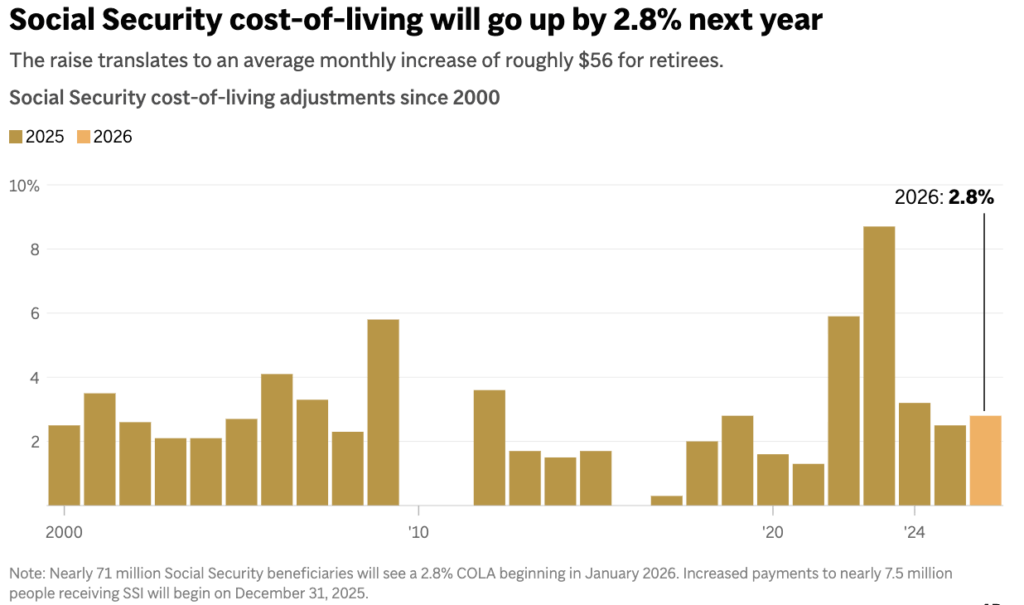
The Social Security Administration’s annual cost-of-living adjustment will go up by 2.8% in 2026, translating to an average increase of more than $56 for retirees every month, agency officials said Friday.
The benefits increase for nearly 71 million Social Security recipients will go into effect beginning in January, while payments to nearly 7.5 million people receiving Supplemental Security Income will begin on December 31. The announcement was delayed because of the recent federal government shutdown.
The cost-of-living increase is financed by payroll taxes collected from workers and their employers, up to a certain annual salary, which will rise to $184,500 in 2026 from $176,100 in 2025. T
he 2026 increase follows a 2.5% adjustment in 2025 and a 3.2% increase in 2024, after a historically high 8.7% bump in 2023 driven by record inflation. Officials said the smaller 2026 increase reflects moderating inflation rates.

Many seniors say the 2.8% Social Security cost-of-living increase 2026 won’t go far enough in helping them meet rising expenses. Linda Deas, an 80-year-old Florence, South Carolina resident, said it “does not match the affordability crisis we are having right now.” Deas, a retired information systems specialist, has seen her rent rise by $400 in the past two years and says grocery and auto insurance prices have also surged.
A recent AARP poll shows that only 22% of Americans over age 50 believe a 3% cost-of-living adjustment is enough to keep up with inflation, while 77% disagree. The sentiment is shared across political lines. AARP CEO Myechia Minter-Jordan said the COLA remains “a lifeline of independence and dignity” for older adults but added that many still struggle to cover basic needs.
According to the MIT Living Wage Calculator, an adult living alone in Florence would spend $10,184 annually on housing, $3,053 on medical expenses, and $3,839 on food—numbers that continue to rise faster than annual benefit adjustments.
The Social Security Administration’s announcement comes during a period of internal upheaval. The agency has faced layoffs of thousands of workers as part of the Trump administration’s efforts to reduce the federal workforce. Officials have also had to clarify statements that sparked concern about the future of Social Security.
In July, Treasury Secretary Scott Bessent walked back comments suggesting that a new children’s savings program was a “back door” to privatizing Social Security. In September, Commissioner Frank Bisignano also clarified that raising the retirement age “is not under consideration at this time,” despite earlier statements implying it might be reviewed.
The 2026 cost-of-living adjustment arrives as Social Security faces a potential funding shortfall. According to the June 2025 Social Security and Medicare trustees’ report, the trust funds covering old age and disability recipients could become unable to pay full benefits by 2034, leaving the agency able to cover only 81% of payments.
Both the Trump and Biden administrations have introduced temporary relief measures to help retirees. The Trump administration passed a tax deduction for seniors aged 65 and over, though it excludes many low-income beneficiaries.
In 2024, President Biden repealed two policies—the Windfall Elimination Provision and the Government Pension Offset—that previously limited payouts for nearly 2.8 million public sector retirees.
Experts warn these measures have accelerated the program’s insolvency. Emerson Sprick, the Bipartisan Policy Center’s director of retirement and labor policy, said cost-of-living increases “can’t solve all the financial challenges households face or all the shortcomings of the program,” adding that broader reforms are needed to secure Social Security’s future.