





AT A GLANCE
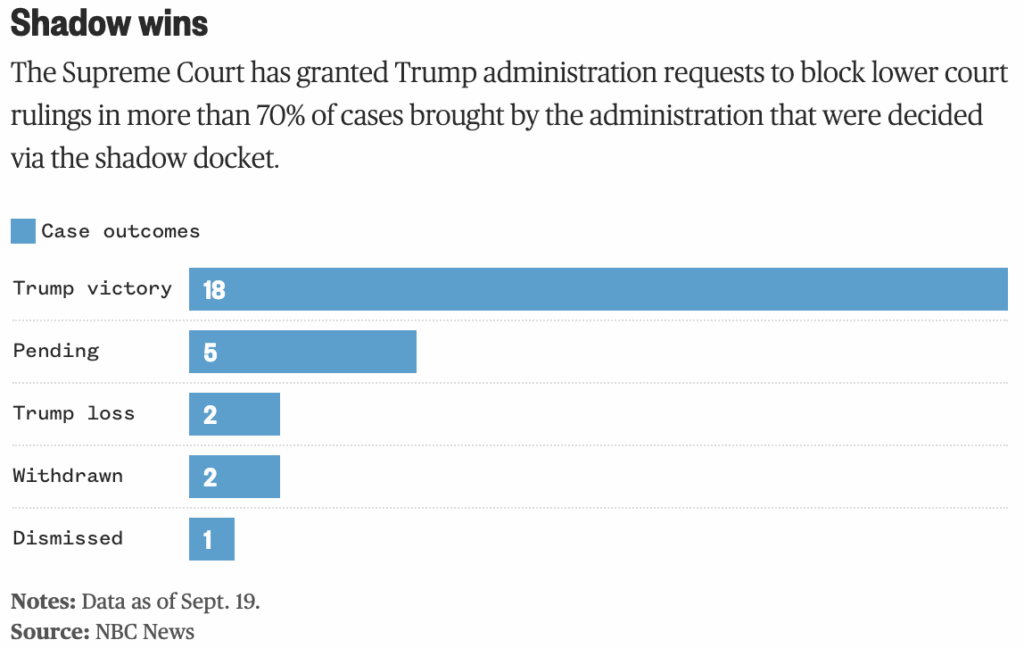
- Trump administration has won 18 cases at the Supreme Court, including a 15-case winning run.
- Strategy centers on picking cases likely to succeed with the conservative majority.
- Key victories include challenges to federal agencies, immigration policy, and military rules.
- Upcoming cases on tariffs and executive power could define the next phase.
White House Strategy Pays Off at Supreme Court
President Donald Trump’s administration is riding high after a string of Supreme Court victories, boasting 18 wins since Trump took office. Officials say much of that success stems from a calculated strategy: only bringing cases they expect the conservative majority to back. The administration is currently on a 15-case winning streak, its last loss coming in May.
“They’re ecstatic,” one source close to the White House told NBC News, noting that officials are careful not to overplay their hand. Despite more than 300 lawsuits filed against the administration, only a small fraction have reached the high court.
Solicitor General Sauer Leads Winning Legal Team
Much of the success is tied to Solicitor General D. John Sauer, a former clerk for Justice Antonin Scalia and one of Trump’s personal attorneys. Sauer argued last year that Trump had broad immunity in relation to his efforts to overturn the 2020 election — a case the court sided with him on.
Sauer has also successfully pushed the court to allow major policy shifts: cutting down federal agencies, blocking protections for immigrants, and barring transgender service members from the military.
Strategic Wins and Rare Losses
The administration has sought emergency intervention from the Supreme Court 28 times, losing only twice. Those defeats came in immigration cases: one blocking the use of the Alien Enemies Act for deportations, and another requiring the U.S. to return Kilmar Abrego Garcia after a wrongful deportation.
Notably, officials have avoided appealing some of their most controversial defeats in lower courts — such as executive orders targeting certain law firms and student protesters against Israel — likely because those cases were “very likely to be losers,” said William & Mary law professor Jonathan Adler.
Big Fights Ahead on Tariffs and Executive Power
Legal experts caution that the real tests are still to come. On the horizon is a high-stakes challenge to Trump’s authority to impose tariffs without congressional approval, as well as his attempt to remove a Democratic member of the Federal Trade Commission without cause.
“They’ve had a very good few months,” said Michael Toner, former chair of the Federal Election Commission. “But the real ballgame still lies ahead.”
Court’s Role in Expanding Executive Power
Elizabeth Wydra of the Constitutional Accountability Center said the administration’s strategy aligns neatly with long-standing conservative legal arguments: strengthening the presidency and weakening independent agencies.
“Their winning streak shows that the court is not particularly interested right now in acting as a constitutional check on the executive,” Wydra said.
While Trump and his allies often lash out at lower-court judges who have blocked policies, the administration has adopted a more respectful tone before the Supreme Court. In May, Sauer assured the justices that while the White House may resist some lower-court rulings, it would always follow the high court’s decisions.
“That is correct,” Sauer told Justice Amy Coney Barrett when asked directly if the administration viewed Supreme Court precedent as binding.