






AT A GLANCE
• Supreme Court allows Texas to use GOP-favored congressional map despite racial bias findings by lower court.
• Map gives Republicans control of 30 of 38 congressional seats, up from 25.
• Ruling freezes a decision that said the map likely dilutes Black and Latino voting power.
• Civil rights groups and Democrats say the decision accelerates the erosion of the Voting Rights Act.
• Texas leaders Greg Abbott and Ken Paxton celebrate the ruling as a political victory.
Politicians and Advocates Call the SCOTUS Decision a Devastating Setback
A divided Supreme Court on Thursday came to the rescue of Texas Republicans, allowing next year’s elections to be held under the state’s congressional redistricting plan favorable to the GOP and pushed by President Donald Trump, despite a lower-court ruling that the map likely discriminates on the basis of race.
With conservative justices in the majority, the court granted Texas’ request for quick intervention because candidate qualifying has already begun and the March primaries are fast approaching.
The court’s order freezes the lower court’s 2-1 ruling that blocked the map, at least until the justices issue a final decision. Justice Samuel Alito had previously stepped in with a temporary hold while the full court considered Texas’ appeal. In an unsigned statement, the justices cast doubt on the lower court’s finding that race played a role in crafting the new districts, insisting instead that Texas lawmakers had “avowedly partisan goals.”
Justice Elena Kagan, writing in dissent for the three liberal justices, criticized the majority for intervening prematurely. By acting now, she argued, the ruling “ensures that many Texas citizens, for no good reason, will be placed in electoral districts because of their race. And that result, as this Court has pronounced year in and year out, is a violation of the Constitution.”
Election law scholar Richard Hasen of UCLA called the order “a green light for there to be even more re-redistricting, and a strong message to lower courts to butt out.” The court has previously blocked lower-court rulings in redistricting cases in Alabama and Louisiana, though those came months before elections, not weeks before candidate filing deadlines closed.
Texas enacted its congressional map last summer at Trump’s urging, designing it to give Republicans five additional House seats. The move triggered a nationwide political chain reaction. Texas was the first to meet Trump’s demands in what has become an expanding redistricting war.
Missouri and North Carolina followed with maps granting Republicans an additional seat each, while California voters approved a ballot measure designed to give Democrats five more seats in response. Legal challenges are now underway in both California and Missouri, though a three-judge panel allowed North Carolina’s new map to stand for the 2026 elections.
While the Trump administration is suing to block California’s maps, it simultaneously urged the Supreme Court to keep the Texas districts in place.
Another case from Louisiana now pending before the justices could further restrict race-based districts under Section 2 of the Voting Rights Act, adding uncertainty to how the current redistricting wave may ultimately shake out.
Texas Attorney General Ken Paxton celebrated the Supreme Court’s stay, claiming the ruling “defended Texas’s fundamental right to draw a map that ensures we are represented by Republicans,” calling the redistricting plan “the Big Beautiful Map.” In a statement, Paxton framed the ruling as part of a broader conservative resurgence: “Texas is paving the way as we take our country back, district by district, state by state.”
Gov. Greg Abbott followed with his own message: “We won! Texas is officially — and legally — more red.”
Democratic National Committee chairman Ken Martin issued a sharply different reaction, calling the map “rigged” and “racially gerrymandered,” and saying the Supreme Court “gave Trump exactly what he wanted: a rigged map to help Republicans avoid accountability in the midterms for turning their backs on the American people.”
Colin Allred, the Democratic U.S. Senate candidate, also condemned the decision, calling it proof that the highest court in the country is now openly tolerating partisan and racial gerrymandering. “As a voting rights lawyer, I’ve spent my career fighting to make sure every Texan has an equal voice. Today’s decision is a setback for representation and for every Texan who believes their vote should count just as much as anyone else’s,” Allred said, arguing the maps were “drawn behind closed doors to protect politicians, not to serve the people.”
He said the plan silences communities of color, weakens working Texans’ political power, and makes it harder for voters to hold their elected officials accountable.
The lower court’s finding, now paused, concluded that the map likely violates the Constitution by diluting the political power of Black and Latino voters. U.S. District Judges Jeffrey V. Brown and David Guaderrama issued the 2-1 ruling, with Brown, a Trump appointee, writing that “substantial evidence shows that Texas racially gerrymandered the 2025 Map.”
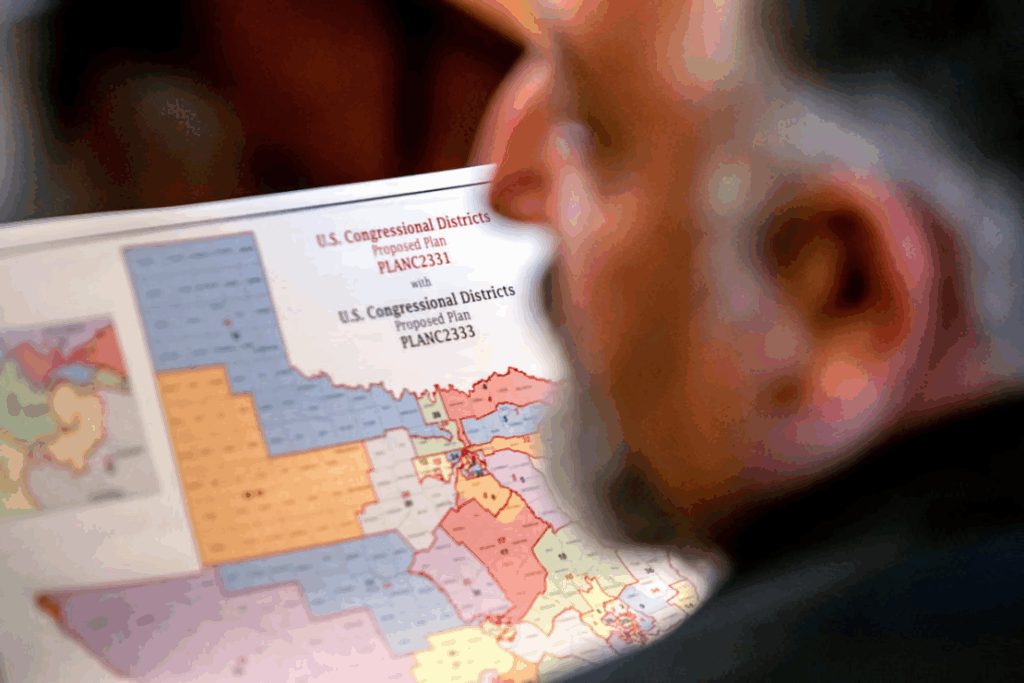
Judge Jerry Smith, the Reagan-appointed appellate judge on the panel, issued a blistering dissent, accusing Brown of “pernicious judicial misbehavior” and complaining he wasn’t given adequate time to review the ruling. Smith went further, saying Brown’s opinion would qualify for the “Nobel Prize for Fiction” if such an award existed. He claimed the “main winners” of the ruling were George Soros and California Gov. Gavin Newsom, and “the obvious losers are the People of Texas and the Rule of Law.”
U.S. Attorney General Pam Bondi hailed the Supreme Court’s stay, writing on X that “federal courts have no right to interfere with a State’s decision to redraw legislative maps for partisan reasons.”
Under the new map, Texas eliminates five of its nine coalition districts, where minority communities collectively outnumber white voters. The total number of congressional districts where minority voters form a majority drops from 16 to 14.
Republicans argue the map actually improves minority representation, pointing to a new eighth Hispanic-majority district and two Black-majority districts where previously there were none. Critics say those majorities are so narrow that white voter turnout rates will dominate the outcome and effectively keep control in Republican hands.
The map and the Supreme Court’s intervention set the stage for a 2026 election cycle shaped not by voters choosing their leaders, but by leaders choosing their voters.