





“Call Your Council Member”: San Antonio City Council Debate Moving Elections From May to November
San Antonio City Council remain split over a proposal that would shift municipal elections from May to November of odd-numbered years, a move supporters say could increase voter turnout and reduce costs, while critics warn the decision is being rushed with limited public input.
The proposal stems from a new state law, Senate Bill 1494, passed earlier this year, which allows cities to move May elections to November of odd-numbered years without voter approval.
The law includes a firm deadline: councils must adopt the change by Dec. 31. If approved, the first election affected would be in 2029.
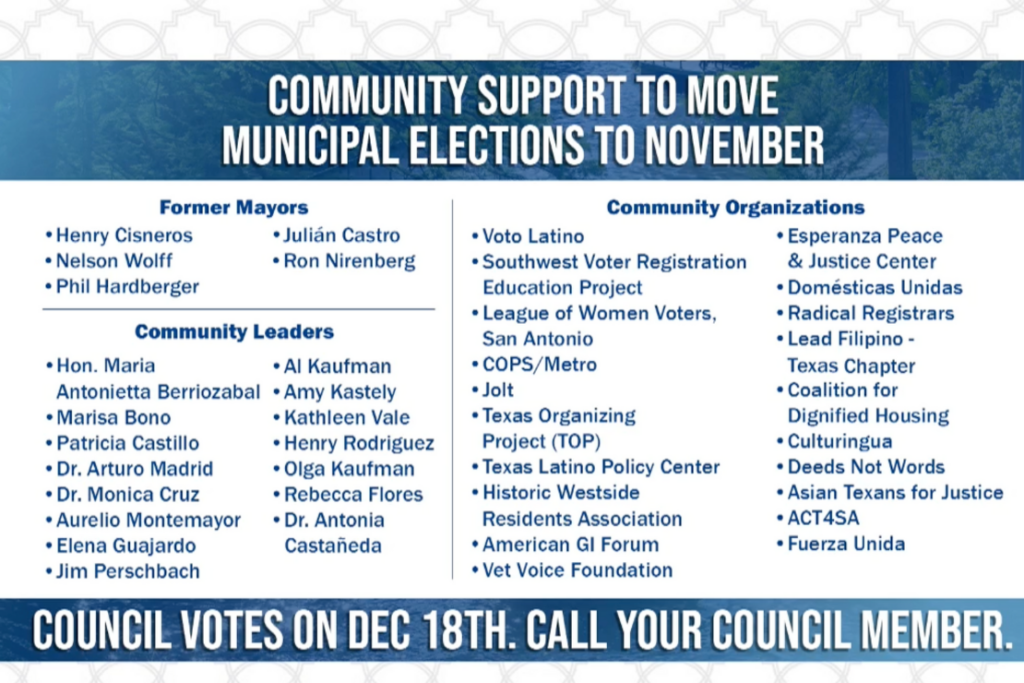
In a Instagram post, Mayor Gina Ortiz Jones said City Council would vote on Dec. 18 on a resolution to move municipal elections from May to November, saying the proposal is both a cost-saving measure and a way to increase participation.
“Our government and democracy works better when we hear from more of our neighbors,” Mayor Jones wrote, encouraging residents to contact their council members in support of the change.
If approved, the change would extend current officeholders’ terms by approximately six months to accommodate the transition. Council members elected in 2029 would be sworn in by early December instead of June.
If the proposal is not adopted, San Antonio would remain on the May election schedule unless future legislative action reopens the option.
During the Dec. 10 City Council session, data presented to council showed turnout in May municipal elections has consistently lagged behind November elections. Recent May elections have seen turnout below 10 percent, compared to nearly 20 percent in November contests.
Research presented to council by political science professors from Rice University and the University of California San Diego suggests cities holding November elections in odd-numbered years typically see higher participation than those voting in May.
Supporters of the change argue the move would reduce voter fatigue and remove logistical conflicts, including San Antonio’s annual Fiesta celebrations, which often coincide with May elections.
District 2 Councilman Jalen McKee-Rodriguez, who represents parts of the city’s historically Black East Side, said the proposal as a step toward reducing barriers to voting.
“We are well aware of voter suppression and efforts to keep turnout low,” McKee-Rodriguez said. “This will reduce barriers to voting, address voter fatigue, improve turnout, and consolidate cost.”
District 4 Councilman Edward Mungia echoed those sentiments, calling the proposal “a step in the right direction” toward improving participation, even if it does not achieve the higher turnout typically seen during even-year elections.
Councilwoman Phyllis Viagran also expressed support, saying the city should act efficiently while continuing broader conversations about voter engagement.
However, a majority of council members voiced concerns about the timing and process. Several noted that the proposal was introduced just weeks before the state deadline, limiting opportunities for public engagement.
District 10 Councilman Marc Whyte said he supports the idea in principle but believes the city should slow down.
“We are not being held at gunpoint to make this decision,” Whyte said. “We can talk about it. We can decide in 2027.”
Other members raised concerns about unintended consequences, particularly for school districts that currently share the May ballot with the city. District 8 Councilwoman Ivalis Meza Gonzalez said the proposal could negatively impact those stakeholders.
“This is not necessarily a bad idea,” she said, “but it’s a rushed idea, and it’s an idea that deserves input from the stakeholders who are the most affected.”
District 1 Councilwoman Sukh Kaur questioned whether the city moving elections unilaterally could “cannibalize” voter turnout for school district elections that remain in May.
District 9 Councilwoman Misty Spears argued that voters should have a direct say before election dates are changed and suggested that moving elections to November of even-numbered years would yield far higher participation.
“I think an odd November election is just a May election with colder weather,” Spears said.
Council members also noted potential confusion among residents, with some mistakenly believing the proposal would align city elections with even-year statewide or presidential contests, which is not permitted under current law.
As debate continues, council members on both sides agree that increasing voter participation is the goal, though disagreement remains over not just the policy itself, but the timing — a recurring dynamic at City Hall.