





Nelson’s Crucial Oral Arguments On Wednesday Sought To Preserve The Heart Of The Voting Rights Act Of 1965
AT A GLANCE
- Janai Nelson, president and director-counsel of the NAACP Legal Defense Fund, argued her first Supreme Court case this week.
- The case, Louisiana v. Callais, could determine the future of the Voting Rights Act of 1965.
- Nelson defended the creation of a second majority-Black congressional district in Louisiana.
- A ruling is expected in summer 2026 and could reshape how racial discrimination in voting is addressed nationwide.
A Historic First for a Veteran Civil Rights Attorney
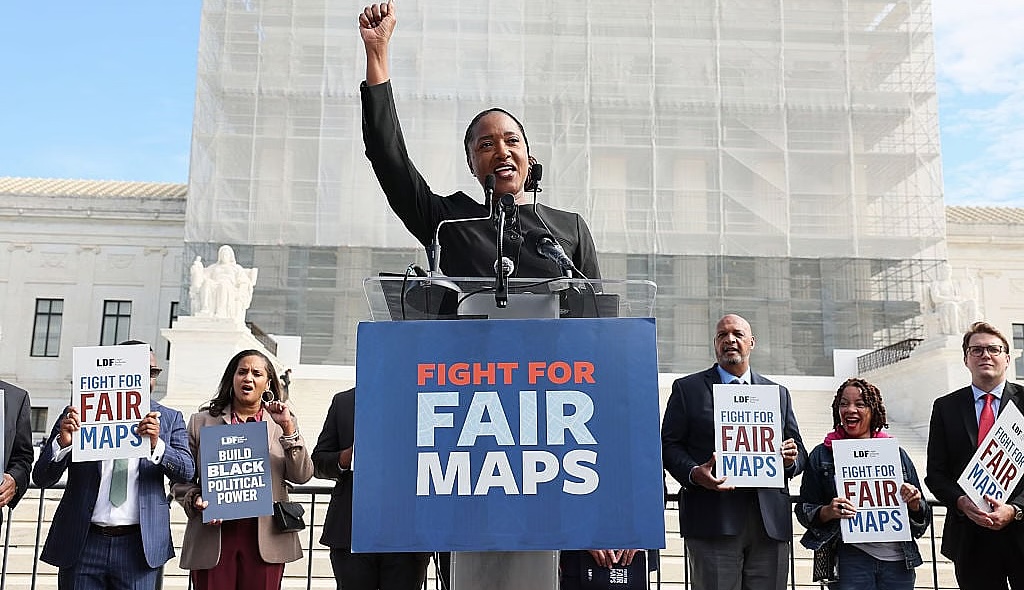
On Wednesday, Janai Nelson stood before the U.S. Supreme Court to defend one of the nation’s most consequential civil rights laws, the Voting Rights Act of 1965. The case, Louisiana v. Callais, could determine whether Black voters in Louisiana, and across America, retain vital protections against racial discrimination in elections.
It was Nelson’s first oral argument before the Supreme Court, marking a historic milestone for the UCLA School of Law graduate and current president and director-counsel of the NAACP Legal Defense and Educational Fund (LDF), the storied organization founded by Thurgood Marshall.
Representing Black voters, Nelson argued in support of a second majority-Black congressional district, what’s known as an “opportunity district” under Section 2 of the Voting Rights Act. “Even if there is some correlation between race and party,” Nelson told the nine justices, “race is the driving factor.”

The Stakes: The Future of the Voting Rights Act
The plaintiffs, a group of white voters supported by the state of Louisiana and the U.S. Department of Justice — claim the map amounts to discrimination against white voters. Nelson countered that it simply remedies generations of racially discriminatory redistricting that diluted Black political power.
Her argument centered on Section 2 of the VRA, which explicitly forbids the denial or abridgment of voting rights “on account of race or color.” The case’s outcome could redefine how the law is applied or if it survives at all.
“I wish we didn’t have to make this argument,” Nelson told The Joy Reid Show. “But I was honored to carry forward the mantle of so many of my predecessors who have done the same thing in challenging this court and forcing this country to be its best self.”
From Scholar to Supreme Court Advocate
Nelson’s legal pedigree is deep. A graduate of NYU and UCLA Law, she has built a career at the intersection of race, democracy, and constitutional law. Before leading the LDF, she served as Associate Dean for Faculty Scholarship at St. John’s University School of Law, where she taught election law and racial equity strategy.
She was also a Fulbright Scholar in Ghana, researching democratic reform and disenfranchisement among citizens with criminal convictions.
Before academia, Nelson clerked for U.S. District Judge David Coar and U.S. Appeals Judge Theodore McMillian. Her scholarship, including “Parsing Partisanship” in the NYU Law Review, examines how courts can address the overlap between racial and partisan gerrymandering — a theme that echoes directly in her current case.
A Legacy of Legal Battles for Justice
Nelson’s decades-long career at the Legal Defense Fund includes a record of high-impact litigation. She led the group’s Political Participation team and was part of cases like Hayden v. Pataki, challenging felon disenfranchisement in New York, and NAACP v. Hood, a voter suppression lawsuit after the 2000 presidential election.
She returned to LDF in 2014 as Associate Director-Counsel, leading challenges such as Veasey v. Abbott, which overturned Texas’s discriminatory voter ID law, and National Urban League v. Trump, which fought Donald Trump’s executive order banning diversity and inclusion training.
Nelson also represented 1619 Project creator Nikole Hannah-Jones in her landmark tenure dispute with the University of North Carolina.
“This Is About American Freedom”
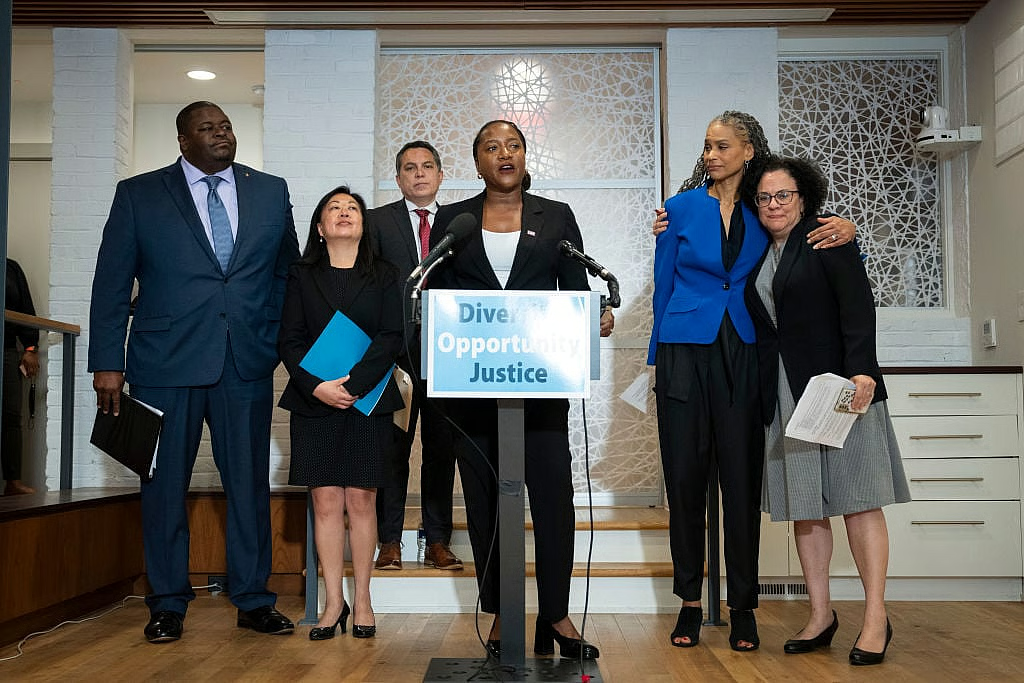
Reflecting on the Voting Rights Act’s legacy, Nelson reminded the court, and the country, that the law was never just about race but about democracy itself.
“Lyndon B. Johnson called it one of the greatest achievements in the history of American freedom,” she said. “It’s about ensuring that we have a robust democracy that fulfills our constitutional obligation.”
Despite the state’s and DOJ’s resistance, Nelson remains optimistic. “I hope we get a 9-0 vote in our favor,” she told Joy Reid. “The law compels that. But we’ll take whatever we get to preserve the Voting Rights Act.”