





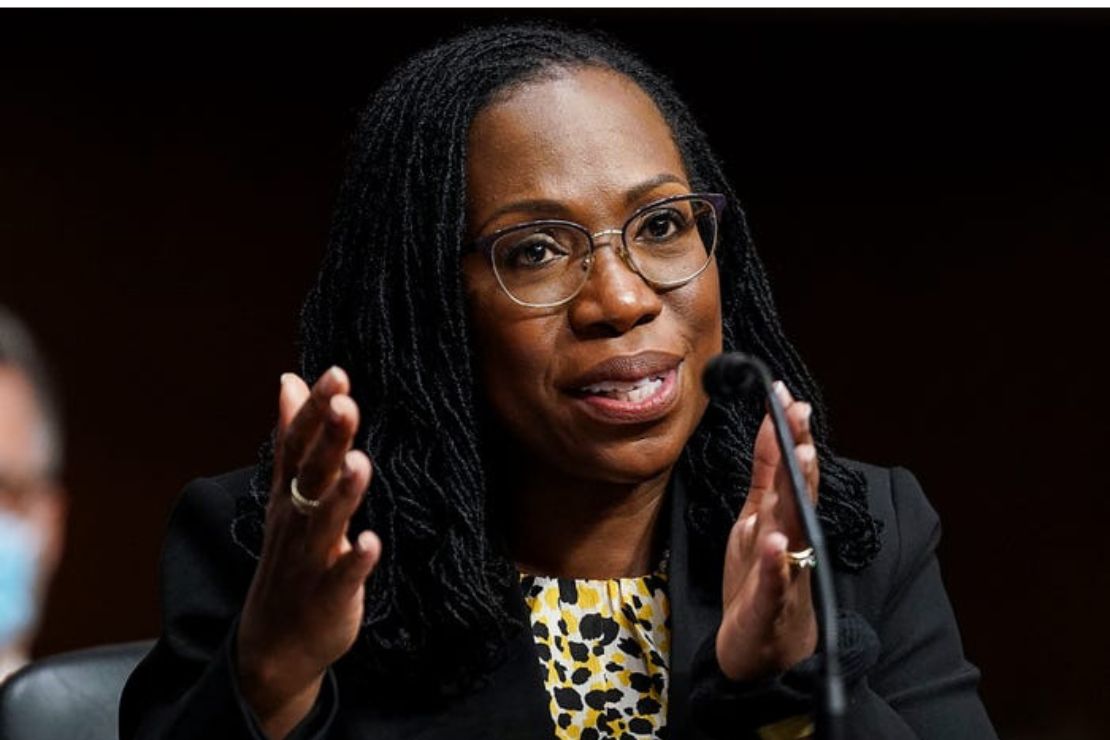
Ketanji Brown Jackson Is Proving That Even the Court’s Newest Justice Can Command National Attention
Clashing from the Bench
During a recent Supreme Court session, Justice Amy Coney Barrett criticized lower court rulings that blocked changes to birthright citizenship under former President Donald Trump. In response, the court’s liberal justices, including Sonia Sotomayor and Ketanji Brown Jackson, pushed back. Sotomayor read portions of a joint dissent aloud—twice as long as Barrett’s remarks—and added, “The other shoe has dropped on presidential immunity,” referencing a 2024 decision limiting presidential prosecution.
But it was Jackson’s written dissent that drew the strongest reaction. Barrett dismissed it, writing, “We will not dwell on Justice Jackson’s argument, which is at odds with more than two centuries’ worth of precedent, not to mention the Constitution itself.”
Calling Out Power and Privilege
Justice Jackson’s dissenting opinions have become a focal point this term. In a case about air pollution rules, she wrote that it “gives fodder to the unfortunate perception that moneyed interests enjoy an easier road to relief in this Court than ordinary citizens.” In another case, she criticized the court for granting the Trump administration access to Social Security data, calling it a “troubling message” that the court is straying from basic legal norms.
At a May judicial conference, she condemned attacks by Trump and allies on judges who ruled against him, warning that “threats and harassment” could erode constitutional protections. Her comments were notably stronger than those of Chief Justice Roberts or even Sotomayor.
Speaking Up Early and Often
Since joining the court in 2022, Jackson has been the most vocal justice by far. In her first two weeks, she spoke more than twice as much as any colleague. Explaining her courtroom approach, Jackson explained she grew accustomed to speaking solo during her time as a trial court judge.
According to Empirical SCOTUS, she spoke 50% more words than Sotomayor this term and authored more opinions, concurrences, or dissents than anyone except Justice Clarence Thomas. “She’s the only one that has ever done what she’s doing in terms of total volume of speech in her first few terms,” said political scientist Adam Feldman.
Going Further Than Fellow Liberals
Jackson has also shown a tendency to go further than her liberal peers. In one ruling involving fuel producers and California emissions standards, she dissented, while Justice Kagan joined the conservative majority and Sotomayor issued her own dissent. Legal analyst Sarah Isgur observed, “You see Justice Kagan really shifting away from Justices Sotomayor and Jackson.”
But Brian Burgess, a former Sotomayor clerk, argued that Kagan’s differences were not major defections. Instead, he suggested that Kagan focuses on coalition-building while Jackson stakes out principled positions, hoping “history comes along to your position over time.”
Rejecting “Pure Textualism”
In another dissent involving disability protections and reduced health benefits, Jackson criticized conservative justices’ embrace of “pure textualism,” writing that it “somehow always [is] flexible enough to secure the majority’s desired outcome.” Legal scholar Steve Vladeck praised her honesty, saying,
“She’s saying what I think so many of us have been thinking.”
Sotomayor didn’t sign onto that footnote, leaving observers to wonder if she disagreed or chose to let Jackson claim the critique alone.
Dissent on Presidential Power
In a case restricting judges’ ability to halt Trump-era policies, Jackson’s solo dissent called out what she described as legal double standards.
“With deep disillusionment, I dissent,”
she wrote, questioning whether courts are now expected to ignore executive lawbreaking. Barrett responded firmly: “The Judiciary does not have unbridled authority to enforce this obligation,” and said Jackson should “heed her own admonition” that judges are also bound by law.
Legal Philosophy: Real People Over Theory
Legal commentator David Lat noted that Barrett’s sharp rebuttal was out of character, suggesting Jackson’s writing struck a nerve. Feldman observed that Barrett emphasizes legal structure while Jackson centers real-world consequences and individual rights.
“When people look back at the Trump case,” Feldman said, “they will be talking about Jackson’s dissent… that’s probably the one from the term that will last the longest.”