






Forty Acres Fresh Market Is Tackling Food Inequity and Reshaping Economic Access in One of Chicago’s Long Overlooked Neighborhoods
In Chicago’s Austin neighborhood, a new chapter in economic empowerment is unfolding inside the walls of Forty Acres Fresh Market.
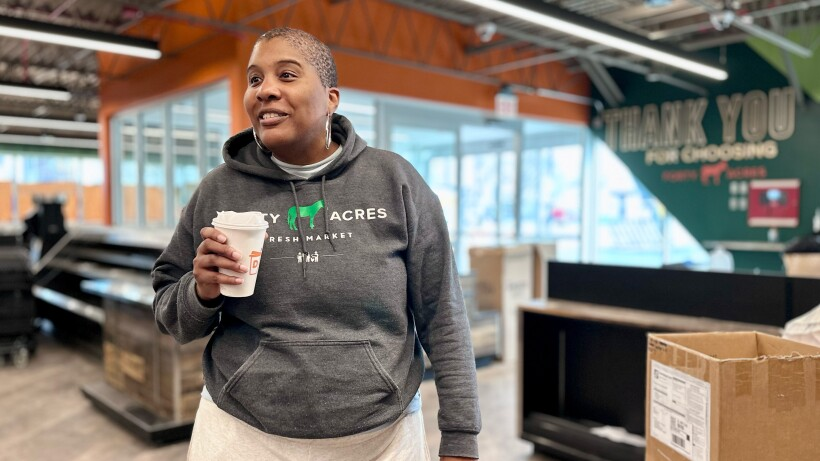
Founded by entrepreneur Liz Abunaw, the Black woman owned grocery store is more than a retail space. It is a direct response to a broken promise that has echoed through generations.
A Name Rooted in History
The store’s name draws from the post Civil War pledge of “40 acres and a mule,” a promise made to formerly enslaved Black Americans that was never fulfilled. Land meant ownership. Ownership meant economic footing. And economic footing meant a path to generational wealth.
Instead of waiting for history to correct itself, Abunaw built her own version of 40 acres in the form of a full service grocery store.
“What would it look like if we actually got our 40 acres?” she asked in a recent interview with CBS News Chicago.
In Austin, it looks like fresh produce, meats, and everyday essentials within walking distance.
Filling a Longstanding Gap in Austin
Austin, located on Chicago’s West Side, has long struggled with limited grocery access. Before Forty Acres Fresh Market opened, residents often had to drive to other neighborhoods or even into the suburbs just to shop for basic items.
Simple purchases such as potatoes or cilantro required time, transportation, and extra expense.
Today, the store stands as the only full service grocery option in the neighborhood. For many residents, it means access without leaving their community.
Transforming Space and Perception
The building itself reflects the transformation.
The space was once a Salvation Army thrift store, marked by heavy concrete block walls and minimal windows. Abunaw described it as feeling like a prison.
Now, bold metal paneling and angular windows flood the store with natural light. Inside, the design blends the feel of a modern general store with the charm of a 1950s ice cream shop. The aesthetic is nostalgic but elevated, intentionally welcoming rather than utilitarian.
The message is clear. This is not a temporary fix. It is built to last.
Business Strategy Meets Community Investment
Abunaw entered the grocery business with experience. A former employee at General Mills, she learned the operational mechanics of large scale food retail before launching her own venture.
She understands the complexity of running a grocery store. Managing supply chains, staffing, pricing, and inventory is no small task. But she also sees grocery retail as a vehicle for broader change.
The store creates local jobs. It keeps dollars circulating within the neighborhood. And it challenges assumptions about Black owned businesses.
Abunaw has pushed back on the notion that Black owned means niche or overpriced. If prices match larger competitors, she argues, that signals competitiveness and sustainability.
Building on a Legacy
Abunaw is careful to acknowledge that she is not the first Black owned grocer. Others paved the way long before her.
Still, at a time when discussions about racial wealth gaps, food inequity, and economic access are front and center, Forty Acres Fresh Market offers something tangible.
It is not just a store. It is a model of ownership, visibility, and community centered investment that resonates far beyond Chicago’s West Side.