




How False Reports of Fire Fueled Violence and Secession in Texas
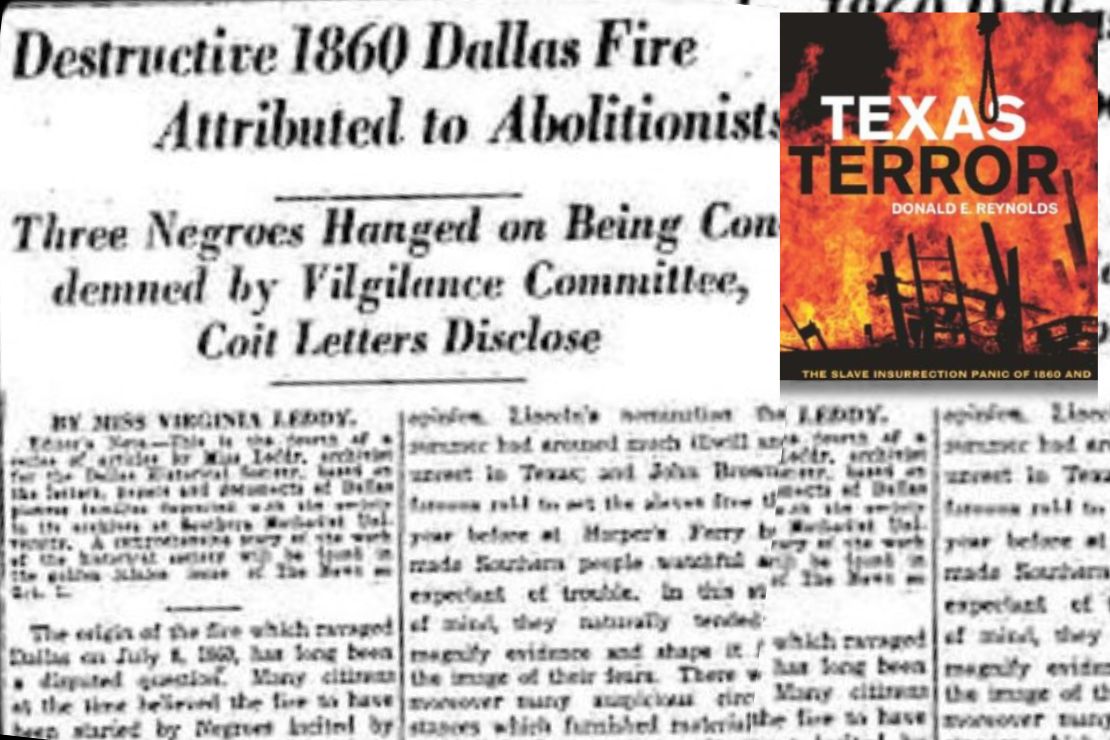
In July of 1860, fires broke out in Dallas, Texas. Of course, white supremacists were looking for an excuse to run amuck and start blaming slaves and Whites that voted or supported Abraham Lincoln, and they did just that. A newspaper in Dallas, called the Dallas Herald, headed by editor Charles Pyror, a white supremacist, found what he was looking for, an excuse to terrorize people using the media and the law to weaponize the situation.
Sought To Invent Fake News
Charles Pyror blamed slaves and “abolitionists” for the fires that also broke out in other nearby towns. He sought to invent fake news that would have racialized Whites running through the streets as mobs. Mob violence, we have seen that today with attack on the Capitol on January 6th, was the weapon of choice then, using the claim that white women were being raped through big lies. This tactic created a panic and unjustified violence broke out. Vigilante groups were formed, we have them even now, which charges Blacks and Whites with being a part of an arson that never took place.
Ink and Lies Across the South
Across the South, racist newspapers reprinted this false story in an attempt to mobilize and organize the South into a force that would later issue Articles of Secession to leave the Union because of their desire to allow slavery to be maintained. These false charges actually led to the Texas Articles that supported slavery as the reason for Civil War. These are not my opinions; this is what the slave owners said themselves. One could lay the blame for the Civil War, in part, on the white supremacist Charles Pyror and the bigots in Texas. Interestingly, Vigilantes harassed the slave owners and threatened to whip any slave owner in San Antonio if “who refused to enforce new restrictions on the movement of their slaves.” These are the words of the San Antonio vigilante committee, as reported in the San Antonio Ledger and Texas of August 30, 1860. Free Blacks, what few there were, were also harassed and put on racist check out lists. The whole racist scam was designed to start the Civil War and terrorize those, both Black and White, that they had better go along with the racialized program.
A Meeting of Madness
It is indeed horrible what racist mass propaganda can do to people. In Dallas, right after the fires, a large crowd of crazed fanatics met. They voted to hang three Blacks and whip “every Negro in the county.” The Blacks were hanged the next day. They were buried by these murderers below the place they were hanged. It is likely that their bodies are still below ground on Commerce Street in Dallas, a short distance from where John Kennedy was shot. It was reported that hundreds of Blacks were whipped in W.H. Parson’s Texas Cavalry book in The Ragged Rebel by B. P. Gallaway. In the meantime, a White man named William Crawford who was murdered by racist mobs was one of many that were hunted down and accused of false crimes simply for being from the North.
The “John Brownite” Label
Whites were accused of being “John Brownites” because John Brown died opposing the cruel system of slavery. John Brown was a national hero for opposing slavery, but in the backward state of Texas, long known for its seething hatred of skin color and ignorance, called Brown the “traitorous Brown” in the San Antonio Herald of August 26, 1860 (San Antonio Alamo Express). The barbaric South had shown its white supremacist fangs in the form of racist rioters.