






GOP Map Shakes Up Political Power Across Major Cities
Texas Republicans are pushing forward with a Trump-backed redistricting plan that would redraw congressional maps mid-decade to flip five Democratic-held seats and solidify GOP dominance. The map—approved by the House Redistricting Committee on a party-line vote—is part of an aggressive political maneuver to expand Republican control from 25 to 30 of the state’s 38 U.S. House seats ahead of the 2026 midterms.
The consequences stretch across the state: entire districts are being dismantled, minority voting strength diluted, and cities like San Antonio, Austin, Houston, and Dallas fractured to maximize Republican advantage.
“This is not about population or fairness—it’s about political performance,” said Rep. Todd Hunter (R-Corpus Christi), the bill’s sponsor.

Lawmakers Walk Out as San Antonio, Austin, and Other Cities Are Redrawn
On Sunday, more than 50 Texas House Democrats, including Rep. James Talarico, fled the state and took refuge nearly 1,000 miles away in a coordinated move to deny the Texas House the two-thirds quorum required to vote on the redistricting bill. Their absence temporarily stalls the fast-track map, which was rapidly cleared through two legislative committees over the weekend.
Talarico, who filed legislation to create an Independent Redistricting Commission, called the map “cheating” and said, “We may not be in Texas, but we’re fighting for our constituents.”
In response, Governor Greg Abbott escalated the standoff by accusing the Democrats of “abandonment or forfeiture of an elected state office.” He has threatened to remove them from the Texas House entirely, citing a legal opinion from the state attorney general, and even suggested extradition—a move likely to spark an intense legal battle.
Talarico also criticized the GOP’s priorities, noting that while Hill Country communities are still reeling from catastrophic floods, Republicans are prioritizing a redistricting scheme designed to protect Trump’s narrow congressional majority.
“We’re not just fighting for Democrats—we’re fighting for Independents and Republicans too,” Talarico said. “Because in a democracy, voters are supposed to choose their politicians—not the other way around.”
San Antonio and Austin: Casar’s District Erased, Doggett Forced to Compete
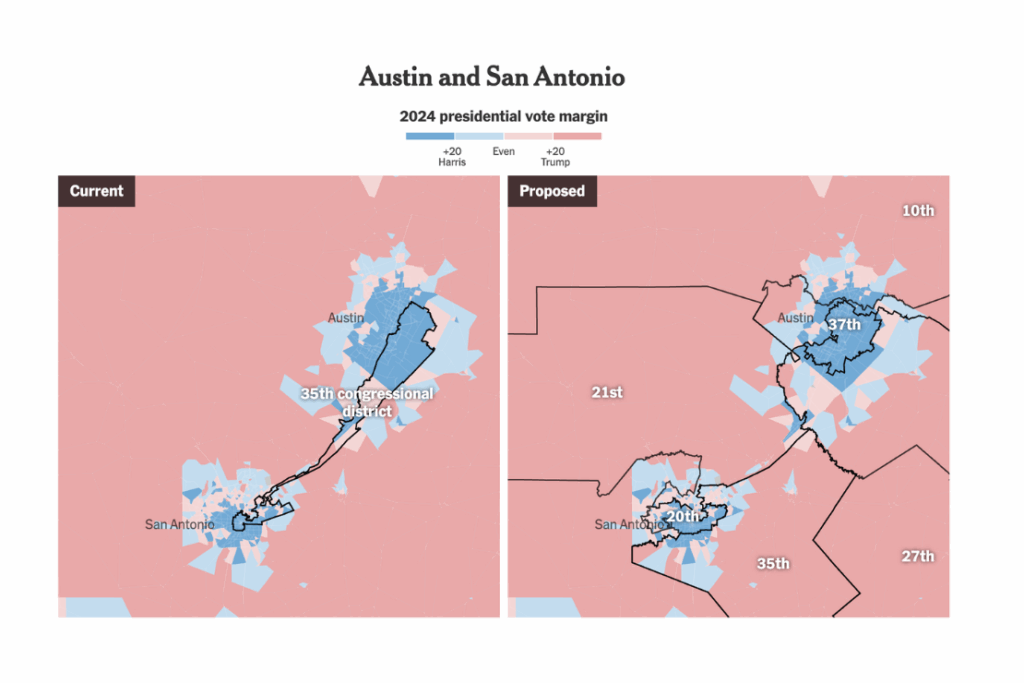
One of the most dramatic changes hits Central Texas. Rep. Greg Casar’s 35th District, which runs from East Austin to the South Side of San Antonio, is gutted. The new map shifts it into a heavily Republican region outside San Antonio, giving Trump a +10 advantage.
Rep. Lloyd Doggett’s neighboring Austin-based district is also absorbed into the shuffle, setting up a potential primary showdown between two progressive Democrats.
“This is illegal voter suppression of Black and Latino Central Texans,” Casar said, calling the move a direct attack on the Voting Rights Act.
Dallas-Fort Worth: Districts Sliced to Favor GOP
In North Texas, Reps. Jasmine Crockett and Marc Veasey—two prominent Black Democrats—are directly targeted. Crockett was drawn out of her own 30th District entirely. Veasey’s 33rd District is now part of a redrawn 32nd, a +18 Trump district, creating a strong pickup opportunity for Republicans in the Dallas-Fort Worth metroplex.
“They know where I live. They asked. And they still sliced me out,” Crockett said, promising to challenge the plan in federal court.
Houston: Al Green’s Seat Relocated, Voters of Color Divided
In Houston, Rep. Al Green’s district is stripped from its majority-Black base and relocated to conservative suburbs east of the city. The map also splits communities of color across multiple Republican-favored districts in Harris and Fort Bend counties.
“This is racial. It is racist,” said Green. “We’re losing representation, and I’m going to stand against it.”
South Texas: Shifting Ground for Cuellar and Gonzalez
Reps. Henry Cuellar and Vicente Gonzalez, moderate Democrats representing South Texas, also see their districts redrawn into deeper-red territory. Cuellar’s Laredo-based district shifts from +7 to +10 Trump. Gonzalez’s McAllen-based seat goes from +5 to +10.
Both have survived close races before, but analysts say these new lines could spell defeat in a GOP-favored midterm year.
What This Means for Voters
This redistricting proposal could fundamentally alter representation for millions of Texans—particularly voters of color and those in urban centers. By moving boundaries to favor Republican candidates, communities are being splintered and their electoral power weakened.
Under the new map:
- GOP would control 30 of 38 seats, despite only 56% statewide support for Trump in 2024.
- Multiple sitting Democratic members would be forced into primaries or Republican-leaning districts.
- Legal challenges are imminent, with Democrats vowing court action and possible walkouts to block a vote.
“This isn’t about representation. It’s about domination,” said Rep. Joe Moody (D-El Paso). “We’re going backward.”
The full Texas House could vote on the map as early as next week. Public testimony is ongoing in Austin, and lawmakers like Jasmine Crockett are urging voters to show up, speak out, and resist.