




For the Second Time in Seven Months, a James Talarico Late-Night Interview Is Moving to YouTube Amid FCC Equal-Time Concerns
For the second time this year, a nationally televised interview with Texas Democratic U.S. Senate nominee James Talarico is being kept off broadcast television amid a growing dispute over federal rules governing candidate appearances.
Jimmy Kimmel announced Wednesday night that Talarico’s scheduled appearance on Jimmy Kimmel Live! would not air Thursday on ABC. Instead, the interview will be released through the program’s YouTube channel, where Federal Communications Commission broadcast regulations do not apply.
The decision comes roughly seven months after Talarico faced nearly the same situation at CBS.
In February, Stephen Colbert interviewed Talarico for The Late Show, but the segment was not broadcast on CBS after network attorneys raised concerns that airing it could trigger the FCC’s equal-opportunities requirements for competing candidates. Colbert instead released the interview on YouTube, where it quickly drew millions of views.
Now, with Talarico facing Republican Ken Paxton in Texas’ November U.S. Senate election, the issue has surfaced again.
FCC Guidance Puts Late-Night Candidate Interviews Under Scrutiny
At the center of both disputes is Section 315 of the Communications Act, commonly called the FCC’s “equal-time” rule.
The law generally requires a broadcast station that allows a legally qualified candidate to use its facilities to provide comparable opportunities to other legally qualified candidates seeking the same office. But Congress created exemptions for certain news programming, including bona fide news interviews.
Late-night and daytime talk shows have historically been able to qualify for that exemption.
Related: James Talarico Interview Pulled Over FCC Equal Time Concerns
That landscape became less certain on Jan. 21, when the FCC’s Media Bureau issued guidance saying broadcasters should not assume that late-night or daytime talk shows automatically qualify as bona fide news programming. The bureau said programming “motivated by partisan purposes” could be subject to the equal-opportunities requirement.
Importantly, the FCC did not rewrite Section 315 or formally eliminate the bona fide news interview exemption.
FCC Commissioner Anna Gomez, the commission’s Democratic member, said after the January announcement that the commission had adopted no new regulation, interpretation or Commission-level policy altering the longstanding framework. She argued, however, that the guidance could pressure broadcasters to avoid political interviews rather than risk regulatory action.
That uncertainty appears to be having real-world consequences for network programming.
Talarico Says His Campaign Is Being ‘Censored. Again.’
Talarico blamed the Trump administration and the FCC for the ABC decision.
“Tonight, I was scheduled to appear on Jimmy Kimmel Live. Because of Trump’s FCC, my interview will not air,” Talarico said in a statement. “Our movement is being censored. Again.”
Talarico directly connected the Kimmel decision to his February appearance with Colbert.
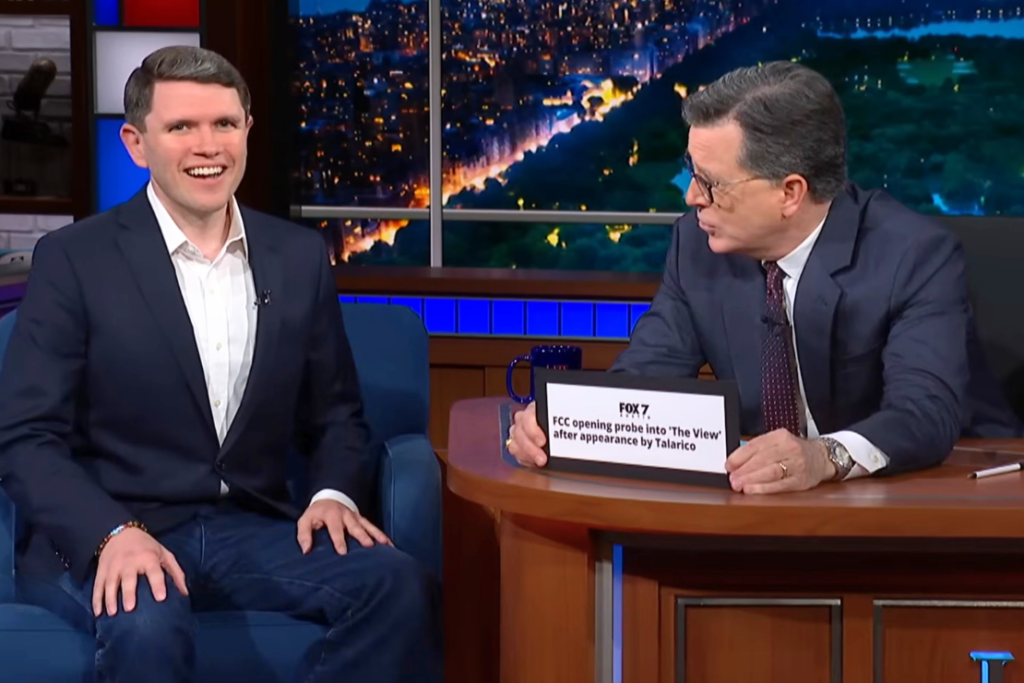
“This is a repeat of what happened with my interview with Stephen Colbert,” he said. “The party that ran against cancel culture is now controlling what we read, what we see, and what we watch. We know they are worried that we are about to flip Texas.”
Related:
He also pointed to Donald Trump’s previous appearance on Kimmel’s program while running for president.
“But when I’m supposed to do one late night interview — on the same program Donald Trump appeared on as a candidate, no less — it’s apparently a non-starter,” Talarico said.
Kimmel similarly criticized the regulatory environment surrounding the decision, saying political candidates have appeared on late-night television for decades without networks treating every interview as requiring matching airtime for an opponent. Reuters reported that Kimmel said the ABC decision came amid FCC pressure and concerns for the network and its affiliates.
The February episode illustrates the unusual distinction the controversy has created between television and the internet. CBS did not air Colbert’s Talarico interview, but the same conversation could legally be distributed through YouTube because the FCC’s broadcast political rules do not govern online platforms in the same way.
That interview ultimately reached millions of viewers online.
Seven months later, Talarico is heading to YouTube again — this time as Texas’ Democratic Senate nominee and just weeks before voters begin deciding whether he or Paxton will represent Texas in the U.S. Senate.
The episode leaves a broader question hanging over the 2026 campaign: whether regulatory uncertainty surrounding the equal-opportunities rule will cause broadcasters to increasingly avoid candidate interviews that historically would have been treated as bona fide news programming.
Talarico’s complete Kimmel interview is now released on the Jimmy Kimmel Live! YouTube channel.


