




The New Sculpture Restores Prominent Recognition to the Longtime City Records Manager After Renovations Reduced the Visibility of His Name on the Building
More than two decades after San Antonio placed George Whitfield Jr.’s name prominently across the Municipal Records Facility, and nearly a year after questions surfaced over why that recognition had been dramatically reduced, the city unveiled a new sculpture Tuesday morning bearing Whitfield’s signature at the entrance of the building named in his honor.
Whitfield attended the Sept. 15 ceremony at the Municipal Archives & Records Center, 719 S. Santa Rosa, where the metal sculpture now stands along the walkway leading toward the building.

City Manager Erik Walsh and officials from the Office of the City Clerk Debbie Racca-Sittre were also in attendance as Whitfield was recognized for the records system he helped build during more than four decades of municipal service.

The sculpture, created by local art collective Bridge Projects, reproduces Whitfield’s handwritten signature in metal. Positioned prominently near the entrance, it gives visitors a much more visible reminder of whose name the facility carries.
City Clerk Says Sculpture Reflects Whitfield’s Vision
The City of San Antonio said the new sculpture is intended to honor Whitfield’s vision for creating a facility dedicated to housing and preserving municipal records.
“The Municipal Archives & Records Center houses the most important records for the residents of San Antonio, from birth and death certificates to the official historical documents of the City of San Antonio,” City Clerk Debbie Racca-Sittre said.
Racca-Sittre said the concept came from local arts collective Bridge Projects, which envisioned a sculpture built around the silhouette of a historic person’s signature.

“It seemed fitting that Mr. George Whitfield Jr.’s name should be the one to welcome visitors to this important place,” she said.
Whitfield, San Antonio’s first records manager, was known throughout his career for his dedication to making public records accessible while helping organize, preserve and safeguard the city’s governmental history. The city said his work left a lasting impact on how San Antonio maintains and provides access to its records.
Although the facility was named for Whitfield in 2002, city officials said the sculpture is also meant to represent the work performed by generations of municipal employees who preserve the city’s records each day.
From Across the Building to Nearly Out of Sight
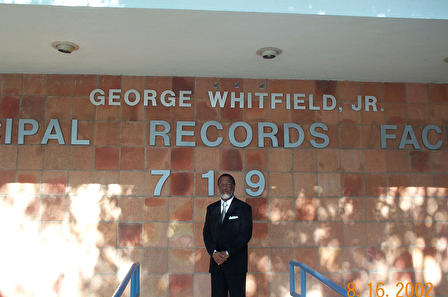
When the Municipal Records Facility was formally named for Whitfield photographs showed “GEORGE WHITFIELD, JR.” stretching prominently across the brick exterior above the words “Municipal Records Facility.”
That changed during an approximately $2 million renovation of the property that began in 2024 and was followed by the opening of the San Antonio Municipal Archives Museum in November 2025.
The large facade lettering disappeared.
Whitfield’s name technically remained on the building, but it had been incorporated in much smaller lettering near the top of a large map-style sign identifying the Municipal Archives & Records Center.
The change was significant enough that Joseph Randle, a former city employee who worked under Whitfield and remained his longtime friend, initially believed the name had been removed altogether.
Related: Once Across the Building, San Antonio City Clerk’s Office Reduces George Whitfield’s Name
After visiting the facility in November 2025, the San Antonio Observer confirmed that the name was still present — though dramatically reduced from the recognition Whitfield had received for more than 20 years.
Randle described the change as having “greatly deprecated” Whitfield’s recognition and argued that Whitfield deserved “pride of place” at the facility created from work he helped lead. He later filed a public information request seeking records related to the removal of the original lettering, costs and work orders associated with the changes, displays honoring Whitfield and records concerning the City Council action that named the facility after him.
The city responded in January that, after an “extensive, good faith effort,” it had located only a limited number of responsive records. One of the records referenced a contract involving a Municipal Archives and Records Center sculpture.
Randle said he never received a clear explanation for why Whitfield’s name had lost its original prominence. What eventually emerged was what Randle described as a “compromise,” a plaque near the flagpole that would provide additional exterior recognition for Whitfield.
Though that plan ultimately evolved into something more prominent, with a signature sculpture now standing along the walkway at the building’s entrance.

A Permanent Signature for the Man Behind the Records
Whitfield’s connection to the facility stretches far beyond the name on the building.
Born and raised on San Antonio’s East Side, Whitfield joined the City of San Antonio on Nov. 1, 1960, and remained in municipal service for more than four decades before retiring Jan. 30, 2002.
He became San Antonio’s first municipal records manager and helped move the city from an outdated box-and-file system toward a centralized records operation that later incorporated computer technology.

Under Whitfield and his staff, the records operation grew to manage tens of thousands of cubic feet of documents and millions of microfilmed records while developing retention schedules for departments across city government. The operation preserved police and fire records, city documents and other materials documenting San Antonio’s institutional history.
City Council formally honored that work by naming the Municipal Records Facility for Whitfield in 2002.
Twenty-four years later, the new signature sculpture places Whitfield’s legacy at the center of the entrance again, ensuring generations who walk through or pass by the building will see the name of the man whose life’s work helped shape and modernize the city’s records system.
Editor’s Note: This story was updated to include comments from City Clerk Debbie Racca-Sittre and additional details from the City of San Antonio about the sculpture’s design and purpose.


