




Five Democrats and Three Republicans Could Reshape a History That Includes Just Three Elected Black Governors
For nearly 250 years, only three Black Americans have been elected governor of a U.S. state.
This November, voters could dramatically expand that short list.
Eight Black major-party candidates have advanced to gubernatorial general elections across the country, creating an unprecedented field that spans party lines, regions and political ideologies. Five are Democrats and three are Republicans, with Black nominees running in Georgia, Minnesota, Nevada, Florida, Michigan, Wisconsin, South Carolina and Maryland.
Among them are two Black women with an opportunity to accomplish something that has never happened in American history, to become the first Black woman elected governor of a state.
Maryland Gov. Wes Moore, meanwhile, is seeking reelection and remains the only Black governor currently serving in the United States.
Moore told USA TODAY that becoming only the third elected Black governor in a country approaching its 250th anniversary was itself revealing.
“I became the first in my state’s history and now only the third elected in the history of America,” Moore said, calling that record “a bit indicting.”
Virginia’s Douglas Wilder became the first Black American elected governor when voters chose him in 1989. Massachusetts elected Deval Patrick in 2006, followed by Moore in Maryland in 2022. Those are the only three Black Americans ever elected governor, and all three are Democrats and men.
The disparity is striking considering Black Americans make up roughly 14% of the country’s population, according to USA TODAY. Historically, Black politicians have had greater success winning congressional seats in districts with substantial Black populations than winning statewide contests where they must build broader coalitions across largely White electorates.
Now eight Black nominees are attempting to do exactly that.
Keisha Lance Bottoms — Georgia, Democrat
Former Atlanta Mayor Keisha Lance Bottoms won Georgia’s Democratic nomination with 56% of the vote in a crowded seven-candidate primary.
Bottoms served four years as mayor of Atlanta, leading the city through the COVID-19 pandemic and protests following the murder of George Floyd. She previously served as an Atlanta City Council member and judge and later worked in the Biden White House as a senior adviser.

She will face Republican businessman Rick Jackson in November.
If elected, Bottoms would become Georgia’s first Black governor and could become the first Black woman elected governor in U.S. history.
Her campaign also arrives amid signs of increased political engagement among Black voters in parts of the South. USA TODAY reported that average primary turnout across Louisiana, South Carolina, Alabama and Georgia was about 26% this year, but rose to 32% in majority-Black counties — a gap significantly larger than during the 2022 midterm primaries.
Lisa Demuth — Minnesota, Republican
Minnesota Republican Lisa Demuth could make the same national history as Bottoms.
A business owner and former school board member, Demuth was elected to the Minnesota House in 2018. She later became Minnesota’s first Black House speaker and the first Republican woman to hold the position.

She will face Democratic U.S. Sen. Amy Klobuchar in November.
A Demuth victory would make her Minnesota’s first Black governor and potentially the first Black woman elected governor in the United States.
Demuth has generally avoided centering race in her campaign, telling the Associated Press she has “never led with any type of identity politics,” while still acknowledging the historic nature of the election.
Aaron Ford — Nevada, Democrat
Nevada Attorney General Aaron Ford already knows what it means to make history.
Ford became Nevada’s first Black attorney general in 2019 after previously serving in the Nevada Senate, where he rose to majority leader.

His path to statewide office included struggles far removed from the traditional political résumé. Ford became a single father while still in college and relied at times on Medicaid and food assistance. He later earned five degrees, including a law degree and doctorate, and previously worked as a public school math teacher.
He will face Republican Gov. Joe Lombardo in November.
Ford has argued that representation can matter in practical ways, particularly when issues affecting Black communities receive less attention. He told the Associated Press that his perspective informs his focus on issues including civil rights, voting rights and economic policy.
If elected, Ford would become Nevada’s first Black governor.
Byron Donalds — Florida, Republican
U.S. Rep. Byron Donalds won Florida’s Republican nomination with the backing of President Donald Trump.
Before entering Congress in 2021, Donalds served in the Florida House of Representatives and worked in banking, finance and insurance.

He will face Democrat David Jolly, a former Republican congressman, in the general election.
A Donalds victory would make him Florida’s first Black governor and the first Black Republican elected governor in U.S. history.
Despite that possibility, Donalds has largely declined to make race a central theme of his campaign. After winning the nomination, he told reporters he was aware of the history but would leave others to write about it.
John James — Michigan, Republican
Michigan Republican John James brings a military and business background to his gubernatorial campaign.
A West Point graduate, James served eight years in the Army as a Ranger-qualified aviation officer and flew Apache helicopters during Operation Iraqi Freedom.

After returning home, he joined his family’s supply-chain business before entering politics. James ran twice for the U.S. Senate before winning election to Congress in 2022.
He will face Democrat Jocelyn Benson in November.
If elected, James would become Michigan’s first Black governor.
David Crowley — Wisconsin, Democrat
David Crowley became both the youngest person and first Black person elected Milwaukee County executive when he won the office in 2020.
Crowley’s rise into government followed a childhood marked by poverty and housing instability. Before becoming county executive, he served in the Wisconsin State Assembly. He is now the Democratic nominee for governor and will face Republican Tom Tiffany in November.
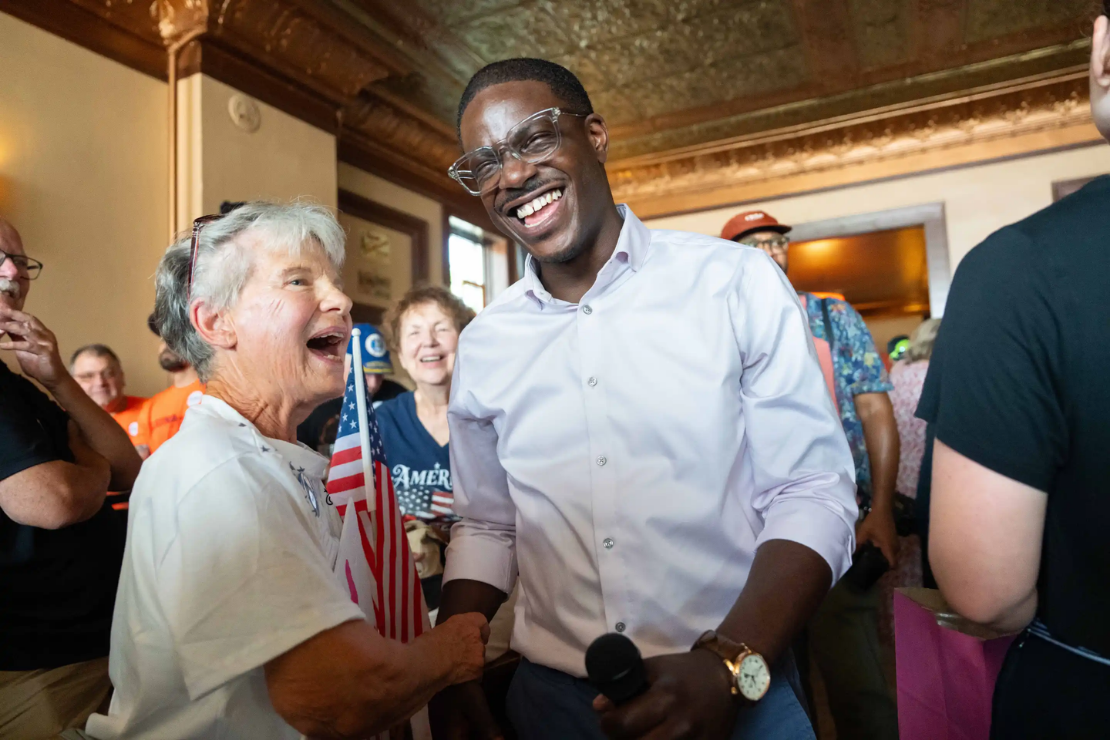
A victory would make Crowley Wisconsin’s first Black governor.
Crowley has said he views the historic nature of his candidacy as bigger than becoming a political first himself.
“My job is not to become the first,” Crowley told reporters, saying he instead wants young people across Wisconsin to be able to see greater possibilities for themselves.
That message reflects a broader challenge facing Black statewide candidates: winning enough voters outside traditional Democratic and Black political bases to carry an entire state.
Jermaine Johnson — South Carolina, Democrat
South Carolina state Rep. Jermaine Johnson took an unconventional path into politics.
A former college basketball player who later played professionally, Johnson earned a doctorate in organizational leadership and founded a nonprofit focused on helping people develop employment skills.

He has represented a Columbia-area district in the South Carolina House since 2020.
Johnson will face Republican Alan Wilson in November.
He is seeking to become South Carolina’s first elected Black governor in a state where nearly one-quarter of the population is Black.
Johnson faces one of the more difficult political environments among the eight candidates. South Carolina has not elected a Democratic governor since 1998.
Still, his candidacy comes as Black primary participation in several Southern states has increased. As democratic strategists say they see signs of heightened political engagement among Black voters heading into November.
Wes Moore — Maryland, Democrat
Maryland Gov. Wes Moore is the only candidate among the eight who has already reached the governor’s mansion. A Rhodes Scholar, Army veteran, author and former nonprofit executive, Moore became Maryland’s first Black governor when voters elected him in 2022.
He is seeking a second term against Republican Dan Cox, whom he defeated in their 2022 gubernatorial contest.

Moore has also taken an increasingly active role in supporting other Black gubernatorial candidates nationally.
Now chair of the National Governors Association, Moore said that increasing Black representation in governors’ mansions is about more than celebrating political milestones.
He said voters should not assume the election of leaders such as Barack Obama, Kamala Harris or himself means the push for representation is finished.
“It’s important that we’re vigilant,” Moore said, adding that political power should not be surrendered after generations fought to obtain it.
Eight Candidates, Eight Very Different Political Landscapes
While the candidates share a historic distinction, their paths to victory differ considerably.
Trump carried six of the eight states represented by the Black nominees in the 2024 presidential election: Florida, Georgia, Michigan, Nevada, South Carolina and Wisconsin.
Only Florida and South Carolina backed Trump in both 2020 and 2024. Minnesota and Maryland supported Democratic presidential candidates in both elections, while Georgia, Michigan, Nevada and Wisconsin shifted from Joe Biden in 2020 to Trump four years later.
That gives some candidates clearer paths than others.
Moore is an incumbent Democrat running in reliably Democratic Maryland. Donalds is competing in Florida, which has moved increasingly Republican.
Demuth faces a tougher environment as a Republican running in Minnesota against a well-established Democratic statewide officeholder.
Johnson must overcome South Carolina’s longstanding Republican advantage.
Meanwhile, Crowley, Bottoms, Ford and James are campaigning in states that have demonstrated an ability to move between the two parties.
History Has Already Been Made
Winning a nomination is not the same as winning a governor’s mansion, and the eight candidates enter November with very different odds. But the historic nature of the 2026 election does not depend entirely on who wins.
Eight Black major-party nominees are running for governor in the same election, where five are Democrats and three are Republicans. Seven could become the first Black governor of their respective states, while Moore is seeking another term as Maryland’s first Black governor.
Bottoms and Demuth could each become the first Black woman elected governor anywhere in the United States.
And Donalds, Demuth or James could become the first Black Republican ever elected governor.
The milestone also highlights how uncommon Black representation remains in some of the nation’s most powerful elected offices. USA TODAY noted that only 14 Black Americans have ever served in the U.S. Senate through election or appointment, while Black candidates historically have had an even harder time reaching governors’ mansions.
Moore has argued that those numbers should keep the focus on what remains unfinished rather than simply celebrating the progress already made. After nearly 250 years in which voters elected only three Black governors, eight Black nominees will appear on gubernatorial ballots at the same time this November.


